Saturday, 12 May 2012

Olympic torch begins journey from ancient Olympia to London

As the flame is lit from the sun's rays by the high priestess Ino Menegaki, a white dove flies into the sky, and women weep

It was a majestic moment. The clouds came and then they went and in between the sun popped out. In that moment Ino Menegaki, the highest of "high priestesses", gathered before the great stone alter of the temple of Hera, took her torch, placed it in a parabolic mirror and lit it from the sun's rays. In a second, it seemed, the Olympic flame was born. The journey to the London 2012 Games had begun.
Most of us were gathered on the grassy banks above ancient Olympia's stadium. Those allowed into the sanctuary, the most sacred part of this most sacred place, were dignitaries and in the hushed silence of the lighting of the flame, as a white dove flew into the skies, the women among them wept.
"It was the first time I have ever seen that happen," said Tassos Papachristou of the Hellenic Olympic Committee, "and they were all British."
The symbol of fellowship and harmony aglow, the search began for an olive branch – the symbol of peace and a vital part of this great ancient ritual. And, when that was found, the high drama continued as the priestesses made their way out of the sanctuary, their cream robes flowing in the breeze that for a moment appeared to extinguish the flame, before Menegaki, an actress who has been performing the ceremony for years, relit the torch from one of the many backups the organisers ensure are always there.
"It was nothing really, just a momentary pause," said Papachristou, who has witnessed the ceremony at the home of the ancient Olympics countless times. "We always have two or three in reserve."
Then the priestesses came over the mound, some dancing, some walking, before those in the stadium – around 2,000 Britons, Greeks and an assortment of tourists – erupted into rapturous applause.
There were men among them also attired in ancient garb. And as they danced and the women gyrated – in honour of Apollo the god of light – Spyros Gianniotis, the British-born Greek 10km swimming world champion, given the privilege of being the first torch-bearer, waited below.
"It was very moving," enthused Lord Coe, head of the 2012 London Olympics organising committee, as dignitaries mingled afterwards over cocktails and canapés. "Greece is where I first competed as an 18-year-old in an international competition 37 years ago," he said, recalling his "backpack" days touring the sites including ancient Olympia. "I took part in two Olympic games after that. In a way this has completed my own Olympic journey," added the double gold medal winner.
He told the crowd the flame was the great connector "between the ancient Games and the modern Games, cities, towns and villages across Greece and Britain."
After 5,000 years the Greeks are good at this sort of thing. And, after the first modern Olympic flame lighting ceremony (held at Hitler's request for the 1936 Berlin Games) they have got better.
But then, nothing evokes Greece's historic, or even mystic, sense of mission more than ancient Olympia, the birthplace of the Games – even in the midst of its worst crisis since the second world war.
For it was here in the verdant valleys and foothills of a remote corner of the Peloponnese that the Gods first wrestled and men – laying down their arms for "a sacred month" in a land riven by disputes and divided by war – subsequently wrestled and learned to be heroes too.
"No other site in Greece incites a feeling of peace and concord in you so gently, so compellingly," wrote Nikos Kazantzakis, the acclaimed modern Greek author. "With unerring eyes the ancients designated it as the place where all the Greek stocks would meet together in brotherhood every four years and in so [doing] they filled it with meaning and increased its tranquillity." It was the perfect place to meld harmony of mind and body, "the Greeks' supreme ideal".
Perhaps because of this, Gianniotis, a towering man, was almost at a loss for words to describe how he felt as the first to take the flame.
The Olympic symbol will travel almost 2,000 miles through Greece before it is officially handed to the London organising committee in Athens and flown, in its own seat in a custom-made box, on a British Airways plane on 17 May. From the Royal Navy airbase at Culdrose, Cornwall, where it lands, it begins a 70-day, 8,000-mile torch relay across Britain before reaching the Olympic Stadium in Stratford, east London, on the evening of 27 July for the opening ceremony of the Games.
"It was a unique moment," said Gianniotis, who ran through the stadium with torch and olive branch in hand followed by a cameraman on wheels. "It is an honour to compete in an Olympic Games but it is an even bigger honour to carry the flame."
Alex Loukos, 19, who was born and raised in Newham, east London, was the second torch-bearer. "I don't know if I can find the words," he said. "I'm British but I'm also half Greek. I'm both. It's emotional. This is a very big day."
His mother Sue, a receptionist, said: "He's been a bit nervous today. I think it's been all the anticipation. It's huge."
Each of the 8,000 torchbearers will run about 300 metres with the flame. In Greece, where it will cross mountains and rivers and seas, passing through 40 towns and 26 prefectures, 38 municipalities and five archaeological sites, organisers admit that this time round it will be a forlorn journey.
Mired in their worst recession in living memory, with little sign of light at the end of the tunnel, debt-stricken Greeks appeared in no mood to rejoice at the flame's lighting. In Athens, where television channels reporting on the country's economic crisis relegated it to the third news item, the euphoria that usually greets the lighting was replaced by a collective sense of foreboding that appears to have taken a hold over the nation. The relay has for the first time only been made possible thanks to private sponsorship.
"We were lucky to have sponsors such as BMW and Procter and Gamble who have helped us foot the bill for the ceremony and the relay," said Spyros Capralos, head of the Hellenic Olympic Committee. "We couldn't ask a state that can't even pay pensions and wages to do it." Capralos, a shipping magnate, admitted he had used "a lot of my own contacts" to help raise the funds.
In ancient Olympia flame-loving locals, however, are putting on a brave face. If the flame had a sex, it would be female, they say, and called Elpida (Hope). "It always carries a message of optimism with it," said Apostollos Kosmopoulos, a local bookshop owner who has been a torchbearer twice in the past 30 years. "Even in these difficult times."
So there goes the flame born from the sun on a ray of hope. London 2012 get ready. She is coming your way.

Yemenis choose jihad over Iranian support

The 'Guevara of south Yemen' describes how activists fighting for independence have become pawns in a larger power struggle


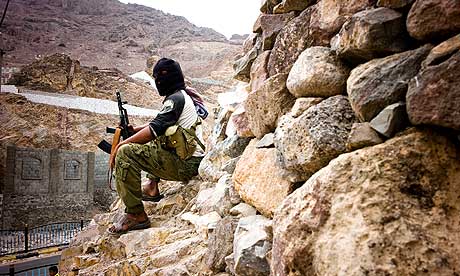
One of the ‘birds of heaven’ militants at a roadblock in Aden.


One of the ‘birds of heaven’ militants at a roadblock in Aden. No one knows whether the gunmen are jihadis, separatists – or both. Photograph: Ghaith Abdul Ahad for the Guardian
Jemajem is a young, dark-eyed militant leader who bears the self-important nom de guerre of "the Guevara of south Yemen". Based in the impoverished port of Aden, he belongs to the Hirak group of activists, who have been calling for south Yemen to be allowed to secede from the north for half a decade.

It's not hard to see why he thinks an independent future for the south would be better than its current situation. Sadness and poverty settled on Aden many decades ago. The streets are littered with piles of rotting fish and festering rubbish, while haggard men sit on pavements chewing qat to stave off the boredom of unemployment. Cliffs of volcanic rock are crowded with migrants' illegal shacks made of breeze blocks and corrugated iron.

But beneath this layer of grime is a tale of outside interference in Yemen that is likely to bring further conflict and exacerbate the divisions within the country. Shortly after the Yemeni president, Ali Abdullah Saleh, was toppled last November in the Arab spring, Jemajem was approached by an intermediary working on behalf of what the man described as a "friendly country" known for its international support for revolutionary causes.

Jemajem was frustrated: although Saleh had gone, the separatists had not achieved any of their demands. But help was at hand, the man told him. Was he interested? "Of course I was," said Jemajem. "I would take money from the devil if he could help my nation. A drowning man will hang on to a straw."

His encounter with what turned out to be the Iranians is remarkable in itself, but it illuminates the much bigger tale of foreign interference in Yemen, of how the conflicts between the Gulf states and Iran, the US and al-Qaida have reduced parts of Yemen to rubble and are pushing Yeminis into the arms of the jihadis.

When the Iranians approached him, Jemajem was asked to gather a group of Hirak activists and a week later they were flown to Damascus, where they met two officials from the Iranian embassy. According to Jemajem and other activists who travelled with him, the officials told the Yemeni delegation that they would support demands for federalism within Yemen, but not the separate state that Hirak was calling for.

"I told them the people want independence," said Jemajem. "It's not me who decides; my people will condemn me if I agree to federalism."

Days later the Iranians came back and told the Yemenis they would have to go to Tehran to meet more senior officials. They arranged for the 15 Yeminis to fly to Tehran without visas on an IranAir flight. There was no one else on the plane, the activists said, and when they landed they were whisked through security without their passports being stamped.

From then on, they were treated more like detainees than negotiating partners, the Yeminis said. They were taken by bus to a hotel and only allowed to leave under escort, to go to meetings with Iranian officials.

"All the officials we met used aliases," said a female member of the delegation who did not want to be named. "They didn't tell us who they worked for but they asked us many questions." The meetings were held in ministries, but they were not told which ones, and the Iranians often spoke to them in near-perfect Arabic.

"They said Iran would invest in infrastructure projects in the south," said Jemajem. "They said they would build a hospital and pay salaries to the activists. They said they would give me – personally – a few million dollars in the beginning to start paying salaries.

"Most importantly, they said they would send us weapons and train people," he said.

Meddling

The Iranians were looking for a foothold in the peninsula, according to a senior Hirak activist who did not want to be named. Iran and Saudi Arabia have interfered in the affairs of Yemen for years, but their meddling had been exacerbated by the Arab spring.

"The Sunni monarchies, such as the Saudis and Qataris, are supporting the Sunnis in Syria and turning a blind eye to the Shia of Bahrain, and the Iranians are looking for a foothold in the region to pressure the Saudis and to be close to the straits of Bab al-Mandab in case there is war with the Americans," he said.

The narrow Bab al-Mandab strait, where the Red Sea meets the Gulf of Aden off Yemen's south-western tip, is a conduit for all shipping going through the Suez canal, and about 30% of the world's oil passes. Yemen also shares a long and porous border with Saudi Arabia, which stretches for 1,100 miles through mountains and desert, and across which guns, qat and Islamic militants are smuggled into the Gulf kingdom, a historic enemy of Iran.

Young men were leaving quietly to train in Iran, the senior activist said. "They leave in small numbers. I don't think the Iranians are training an army there – we don't need military training. I think they are recruiting them to be future intelligence agents here. But why do you need to recruit an agent in a revolution? Help the revolution and the whole people will come and help you."

Iran is not the only country trying to place spies in the region. This week it emerged that an apparent jihadi bomber involved in a plot to attack an American jet was working with Saudi intelligence and the CIA. The double agent was also linked to a drone strike on Sunday that killed Fahd al-Quso, the leader of al-Qaida in the Arabian Peninsula, who was behind the 2000 attack on USS Cole.

Before 1990, Yemen consisted of two separate states. When British forces left the south in 1967, Marxists took over and it became known as the People's Democratic Republic of Yemen. In 1990, Ali Abdullah Saleh, who ruled the north, negotiated a deal with the southern regime to unify the country under a power-sharing arrangement. The southerners soon had second thoughts, though, and in 1994 war broke out between the northern and southern armies (which had not been unified).

Saleh's forces defeated the south in a matter of weeks and then consolidated their grip over the territory. The result was increased corruption, with the northern elites picking off the best jobs and land. Southerners point to swaths of prime coastal real estate that is fenced off. They say government officials from the south were all sent home and replaced by people from the capital, Sana'a. The contractors who run the gas and oilfields are from the north.

Every night, young and old march in the streets of Aden, waving flags and calling for an end to unification. Spontaneous protests erupt as pupils leave the school gates.

One Friday we followed a procession of 15,000 people marching with the bodies of two "martyrs" who had been killed by police. When the crowds reached the cemetery and began waving their flags, soldiers positioned on high ground overlooking the funeral opened fire, injuring three youths. The furious demonstrators taunted the soldiers, telling them to go to the Abyan region, where Islamist militants had seized control and declared an emirate. Later, a group of young men danced with the old flag of South Yemen in front of the military's armoured vehicles.

Small units of gunmen known as "birds of heaven" fill the city at night. No one knows quite who they are: jihadis, separatists or both. One morning in the Mu'ala district of Aden we saw five of them: short, thin and hungry young men manning a roadblock that was carjacking government buses. We saw them again one night standing on a street corner by the qat market, waiting to attack a police convoy. Another time, a different group of gunmen with faces covered had blocked another road to demand the release of a comrade.

Hezbollah

In an old house in Aden, Jemajem gathered a dozen of his followers. His attire, like his politics, was a mix of every militant and revolutionary trend that has swept through the Middle East. The black shirt; black combat trousers and black keffiyeh wrapped around his head is a nod to the Shia fighters of Hezbollah, while his long unkempt beard and the black hair falling to his shoulder is a salute to the jihadis of south Yemen.

"The youth is agitated, militant and demands freedom," Jemajem told them, "and the only way to get freedom is by grabbing it with your hand. America won't give us freedom – we have to fight for it."

Many years before the Arab spring, he and hundreds of other activists in south Yemen started a peaceful movement demanding freedom, the end of Saleh's autocratic rule and the northern exploitation of the south. The state responded with oppression.

In less than half a decade, Jemajem was jailed six times, beaten up, tortured – including being hanged from the ceiling of his cell for days – and had his hair and beard shaved with a knife. At the end of this experience, he had been transformed from a peaceful demonstrator into a militant leader calling for armed struggle.

The peaceful demonstrators evolved into a separatist movement, Hirak, demanding the "independence" and "restoration of the state of South Yemen". But Hirak followed the trajectory of other Arab uprisings: a mass popular movement without real leaders degenerated into an array of supreme salvation councils and revolutionary committees, each claiming to be the real representative of the people while bickering over personal slights and antagonisms.

"I tell you my brothers, you have to revolt against not only the oppression of the north but also against those who claim to be our leaders," Jemajem told his followers. "The Arab world is deposing its dictators and you are bringing your own. These people are nothing but stuffed mummies."

It was frustration at the Hirak leaders' ineffectiveness that led the group to Tehran. "We went to Iran with a sense of shame," said a woman activist, "because all doors were closed in our faces and only the Iranians offered to help."

What did they say to the Iranians in the end? "We said no," said Jemajem. The Iranians attached a key condition: that the supply of guns would not be controlled by Hirak but by the Houthi rebels in the north – Shia insurgents who have been fighting the central government for almost a decade and are widely believed to be backed by Iran.

"They told us the Houthis would deliver the weapons and the money," said Jemajem. "We are trying to liberate our country from the northerners – I am not going to be under the control of another northerner.

"We realised then that the Iranians want us to be pawns," he said. "I refused to take their money."

On his return from Tehran, Jemajem turned to the jihadis. He spent a few weeks living with them in the nascent Islamic emirate based in the southern Yemeni city of Ja'ar. Although at heart a secular leftist, the "Guevara of the south" was impressed by the Islamists' strength.

"Look at our brothers the mujahideen in Ja'ar," he said to the group gathered in Aden. "They carried weapons and liberated their lands and they have created order. They created something out of nothing. Do you know how? Because the youth of al-Qaida fight for a cause while we in the Hirak haven't put our beliefs in our hearts. We have to sacrifice and die."

At this, some of the assembled young revolutionaries rolled their eyes: most are secular activists who chew qat and smoke, and have little to do with religion.

"Do you want a sharia state?" asked one. "We are fighting for a civil state here. The jihadis won't bring us that."

"I don't want an Islamic state but the jihadis are coming," said Jemajem. He drew a circle on a cushion. "Look, the jihadis are surrounding Aden, they have taken the east [Zanjibar and Ja'ar] and are now attacking checkpoints in the north. Some of their men are already inside the city."

The battle for Aden was coming soon, Jemajem said, and the separatists would be making a mistake to resist them.

"I told our leaders that when the jihadis take Aden, I won't send my men to die fighting them," he said.

"If young men lose hope in our cause they will be looking for an alternative. And our hopeless young men are joining al-Qaida."

Agent in underwear bomb plot 'was British'

Claims that British passport holder played central role in mission that led to death of top al-Qaida operative in Yemen


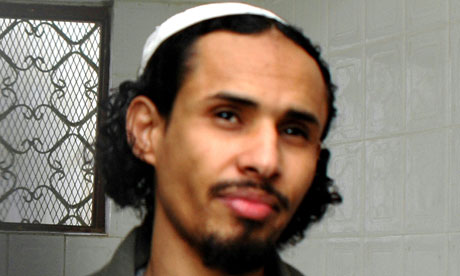
Fahd Al-Quso


Fahd al-Quso, an al-Qaida operative, died in a drone attack on Wednesday. The underwear bomber agent may have been involved. Photograph: Yahya Arhab/EPA
A British citizen played a central role in foiling the latest "underwear" bomb plot hatched in Yemen to attack a US-bound plane, as well as in the assassination of a top al-Qaida operative at the weekend, according to various sources in Washington on Thursday.
CNN reported that the agent involved was a British citizen of Saudi origin who had been recruited about a year ago by Saudi intelligence.
MSNBC, which also reported that the agent was a British passport holder, said that British intelligence was "heavily involved". Other US media outlets gave the Saudi intelligence service most of the credit for the successful running of the operation. The Guardian independently confirmed British involvement.
The agent was recruited by al-Qaida in the Arabian Peninsula (AQAP), which operates in Yemen and Saudi Arabia, and asked to carry a bomb aboard a US-bound plane.
The revelation is politically and legally awkward for MI6 and MI5 whose agents, unlike American ones, are banned from missions that lead to assassinations, such as the US drone attack at the weekend that killed the top al-Qaida operative in the Yemen, Fahd al-Quso. The attack is being attributed to information from the agent.
Such is the sensitivity that America's National Public Radio reported that the British government asked the Obama administration not to reveal the role of British intelligence in the mission.
James Clapper, the US director of National Intelligence, has opened an "internal review" of US intelligence agencies to determine whether there had been leaks of classified information related to the underwear bomb operation.
The FBI is conducting a separate criminal investigation, a law enforcement official said. The US defence secretary, Leon Panetta, a former CIA director, said: "When these leaks take place, they damage our ability to be able to pursue our intelligence efforts."
The agent has not yet been identified but, according to US officials, he was recruited by al-Qaida in the Yemen and given a bomb similar to – but more sophisticated than – the one used by Umar Farouk Abdulmutallab, who was jailed this year for a failed attempt to bring down a plane over Detroit in 2009. That plot also originated in Yemen.
The agent involved in the latest attempt took the bomb and then handed it over. It is now being examined by the FBI at its laboratories in Quantico, Virginia.
The Washington Post reported that the agent was one of several sent into Yemen over the past two years with western passports and other documents designed to attract the attention of al-Qaida.
It is unusual for the US to brief in this way about the internal workings of other intelligence services. It may be that the CIA did not want to be falsely credited with the success in foiling the plot.
The Associated Press learned about the plot last week, but held off reporting it as the request of the White House for what were cited as operational reasons. AP finally reported the story on Monday, the day after the assassination of Quso.
On Wednesday, the US reported that the would-be bomber had been an agent.
The White House declined to confirm or deny British involvement, citing operational sensitivities. A spokesman for the British embassy said: "We do not comment on intelligence matters."
In the past, British intelligence might have been happy to have taken credit for what is being hailed in the US as a major intelligence coup. But not this time.
British officials in London referred all questions from the media to the US.
Their reluctance to comment may be because of the rule that Britain's security and intelligence agencies are not allowed to task their agents for operations deliberately designed to lead to the death of an individual. MI6 was banned in the 1960s from any involvement in assassination plots.
But, according to US officials, the double-agent's mission was to find the bombmaker for AQAP, Ibrahim Hassan al-Asiri, and pass on the location to the US. Over the past month, the CIA has sought and received permission to expand drone attacks in the Yemen.
The disclosure in the US of the plot comes at a bad time for MI6. Its officers are being investigated by the police over the rendition of Libyan dissidents to Muammar Gaddafi's secret police who, the dissidents say, tortured them.
When the US government confirmed the AP story on Monday, it acknowledged the plot had been foiled with the help of other intelligence agencies, without specifying which ones. It has since emerged that the Saudi intelligence service as well as British intelligence was involved.
The British agent would have been attractive to al-Qaida as a bomb-carrier. Al-Qaida has long welcomed sympathisers with western passports, seeing them as more capable of getting through airport security. The agent failed to discover the whereabouts of Asiri. But Quso was killed by the drone attack on the car he was travelling in Shabwa province in Yemen.
Yemen has been the source of several attempts to target the US, including the successful attack on the USS Cole.
On Monday, the Republican Congressman Peter King, chairman of the House homeland security committee and is regularly briefed by the intelligence services and the White House , said he was told by the White House that the intelligence operation and the targeting of al-Quso were connected.
According to CNN, the agent was accepted for training as a suicide bomber and then contacted Saudi intelligence, who in turn informed the US.

How plot unravelled

April According to US officials, al-Qaida in the Arabian Peninsula hatched a plot to bomb a US-bound plane using a more sophisticated device than that used in the failed 2009 "underwear" bomb attempt on a plane over Detroit.
Last week AP learned about the failed plot but held back its report at the request of the White House.
Sunday A CIA drone attack in Yemen killed a a senior al-Qaida operative, Fahd al-Quso.
Monday AP ran its story and the White House confirmed it. But there were no details published about the identity or whereabouts of the would-be bomber. A congressman, Pete King, said the same intelligence operation involved not only stopping the bombing but had identified the whereabouts of al-Quso.
Tuesday The US revealsed the would-be bomber was in fact an agent who had infiltrated al-Qaida pretending to be a volunteer for a sucide mission. It is being taken apart by an FBI forensics team.
Thursday Another twist. Various US sources revealed the agent was a British citizen of Saudi origin.

Andy Coulson: David Cameron asked me about phone hacking only once

PM is said to have sought no fresh assurances from former News of the World editor as phone-hacking revelations emerged


Andy Coulson gives evidence at the Leveson inquiry. Link to this video
The prime minister's judgment moved to centre stage at the Leveson inquiry after Andy Coulson, the former No 10 director of communications, revealed that Cameron and his staff sought no fresh assurances about Coulson's conduct as editor of the News Of the World after the Guardian published stories in 2009 suggesting that phone hacking was rife on his watch at the tabloid.
Coulson also revived questions about why he was not subjected to the same level of security vetting as his predecessors when he told the inquiry he may have had unsupervised access to top-secret documents while working in Downing Street between May 2010 and January 2011.
Coulson's evidence came as the Leveson inquiry began its six-week module examining the relationships between press and politicians, which will eventually see Cameron, Tony Blair and Gordon Brown give evidence before the judge.
Coulson resigned as editor of the News of the World in 2007 saying he took "ultimate responsibility" for what had happened, even though he had no knowledge of the phone hacking that led to the jailing of Clive Goodman, the paper's former royal editor, and the private investigator hired by the tabloid, Glenn Mulcaire. Cameron has insisted he appointed Coulson believing he deserved a second chance.
In his first public appearance since his resignation from No 10 and his subsequent arrest, Coulson was not cross-examined about his knowledge of phone hacking at the paper to avoid any risk of prejudice to any future trial.
But he revealed that the only time Cameron asked him about the court case that had led to Goodman's conviction was at the time of his initial appointment in May 2007. "I was able to repeat what I said publicly, that I knew nothing about the Clive Goodman and Glenn Mulcaire case in terms of what they did," Coulson said. Cameron told him he had conducted some background security checks on him. Coulson's severance terms from News International, owners of News of the World, were also not discussed.
In evidence on Thursday, Coulson disclosed that after the Guardian ran a front-page story in November 2009 suggesting that phone hacking was widespread at the paper Cameron made no fresh inquiries. Asked whether he was questioned by Cameron or anyone else after that date about Goodman and Mulcaire, Coulson said: "Not that I can recall."
By the time Coulson entered Downing Street in May 2010, the Guardian had run more than 90 articles about illegal activities at the News of the World under his editorship, 14 of them on the front page, and Cameron had been warned by a number of political colleagues against hiring him as the No 10 press secretary.
As the Guardian and other newspapers published a succession of disclosures about illegal practices at the News of the World under Coulson, Cameron repeatedly defended him, stating as late as January 2011: "Obviously, when he was editor of the News of the World, bad things happened at that newspaper. I think there is a danger at the moment that he is effectively being punished twice for the same offence."
No 10 refused to explain the prime minister's apparently incurious attitude, saying he would explain his approach when he gives evidence to the inquiry himself, probably in June.
Coulson also told the inquiry that he had unsupervised access to papers marked "top secret" and attended meetings of the national security council even though he had only been through basic security vetting. Unsupervised access to top secret material requires the higher "developed vetting" level of clearance held by most of Coulson's predecessors. No 10 defended its decision not to make Coulson subject to developed vetting on his appointment as government communications director following the 2010 election, saying there had been a conscious decision made by the civil service that fewer special advisers should have access to the intelligence material.
No 10 said a decision was taken to "DV" Coulson only after a terrorist incident at East Midlands airport revealed the extent to which he needed regular access to intelligence material to conduct his job. The six-month vetting procedure had not been completed by the time he resigned.
Coulson disclosed that he retained £40,000-worth of News Corp shares while working at No 10. "Since resigning from my role as Downing Street communications director, I have given thought to one issue which I now accept could have raised the potential for conflict. Whilst I didn't consider my holding of this stock to represent any kind of conflict of interest, in retrospect I wish I had paid more attention to it," he said in his witness statement.
"I was never asked about any share or stock holdings and … it never occurred to me that there could be a conflict of interest."
No 10 said he would have been asked to fill out a form when he was appointed stating whether he had relevant shares that might represent a conflict of interest.
Coulson said he had no involvement in the government's response to News Corp's bid to buy BSkyB, but the Conservatives have already faced calls for an independent inquiry after a series of emails between the News Corp lobbyist Frederic Michel and a special adviser to Jeremy Hunt, the culture secretary, were released to the Leveson inquiry.
Cameron has refused to launch his own inquiry into whether Hunt breached the ministerial code saying he will wait to see what evidence emerges from the Leveson inquiry.
But Leveson in the strongest terms yet said he was not conducting an inquiry into the ministerial code, and could not be arbiter of Hunt's fate.
Leveson ruled: "I will not be making a judgment on whether there has been a breach. That is simply not my job, and I have no intention of going outside the terms of reference that have been set for me."
In what may prove to be indication of the Leveson inquiry's initial thinking, Robert Jay QC, counsel for the inquiry, asked whether the revelations that almost daily updates were being offered by Hunt's office to News Corp on its BSkyB takeover bid could be evidence of an "over-cosy relationship".
"The issue is whether a minister of the crown exercising a quasi-judicial role may have failed to fulfil it because he has demonstrated through his actions that he was too close to News Corporation."
Jay said the "least serious finding" Leveson could make was that Hunt was biased, but the "most serious" was that Hunt was prepared expressly to authorise his special adviser to conduct what in effect were covert communications with the lobbyist or, put another way, provide a running commentary on the bid.

Friday, 4 May 2012

Sudan leader says he will teach independent South a 'final lesson by force'


Reuters reports — Sudanese warplanes carried out air strikes on South Sudan on Monday, killing three people near a southern oil town, residents and military officials said, three days after South Sudan pulled out of a disputed oil field.
A Reuters reporter at the scene, outside the oil town of Bentiu, said he saw a fighter aircraft drop two bombs near a river bridge between Bentiu and the neighboring town of Rubkona. 
Smoke rises after the Sudanese air force fired a missile during an air strike in Rubkona on April 23, 2012.
A soldier in South Sudan's SPLA army walks in a market destroyed in an air strike by the Sudanese air force in Rubkona on April 23, 2012.